
AI Needs You More Than You Think
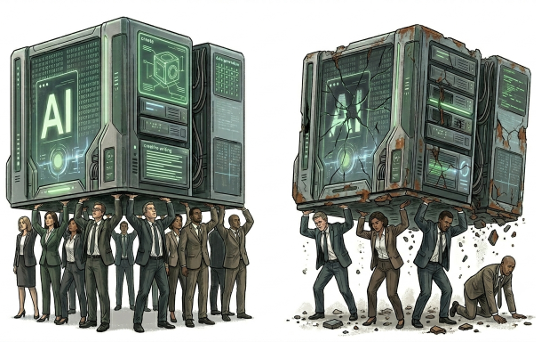
The story being told about AI and the contact centre workforce goes like this.
AI handles the volume. Humans handle the exceptions. Headcount reduces. Cost per interaction falls. The organisation does more with less. It's a compelling story. It's also incomplete in a way that's becoming expensive.
Buried inside that narrative is an assumption almost nobody is examining: that the capability requirement goes down as the headcount does. That the work gets simpler as AI handles more of it. Neither is true. And the organisations discovering it the hard way are the ones who restructured first and asked questions later.
What AI Actually Needs From You
Strip away the vendor narrative and look at what AI genuinely requires.
It needs humans to define what good looks like. The training data, the intent design, the escalation thresholds — all human decisions. Make them badly and the AI executes your poor judgment at scale.
It needs humans to interrogate what it was trained on. AI built on historical contact centre data inherits everything in that data — the workarounds, the compromises, the processes you've spent years trying to move away from. If your agents were compensating for a flawed billing system for five years, the AI learns to compensate for it too — except now the compensation is invisible and systematic rather than visible and human. You're not just automating the present. You're encoding the past. The humans who remember which parts of that past were broken are the only safeguard against repeating them at scale.
It needs humans to catch it when it's wrong. AI systems fail. They hallucinate. They misread situations. The only thing standing between that failure and your customer is someone with enough domain knowledge to recognise the error before it becomes a complaint.
It needs humans to handle what it can't. The emotionally complex. The genuinely ambiguous. Those interactions don't get simpler because AI handled the easy ones. They get harder — because they're what's left.
It needs humans to transfer institutional knowledge. The pattern recognition, the scepticism, the understanding of where the system fails — none of it generates itself. It has to be developed and deliberately passed on.
It needs humans to provide genuine presence. When AI isn't enough — and for the customers who matter most, it often isn't — what they need cannot be automated.
Every one of these requirements demands more from your people, not less.
AI doesn't reduce the human requirement. It changes it — and raises it.
The Measurement Problem
Organisations are measuring the wrong things.
They measure what AI replaces — interactions handled, time saved, cost reduced. But what doesn't get measured is what AI exposes. The quality of judgment when the AI can't resolve something. Failure detection when a model starts producing wrong answers. Knowledge transfer before an experienced practitioner leaves. Those are the capabilities that determine whether your AI investment actually delivers. Most organisations have no idea how to measure them — because they've been so focused on what AI can do that; they haven't asked what AI needs.
What Getting It Right Looks Like
The organisations ahead on this haven't reduced their investment in human capability. They've redirected it. Less focus on processing volume, more on developing judgment. They treat experienced practitioners as a strategic asset. They build AI review into workflows. They ask regularly — what is our AI getting wrong that we haven't noticed yet?
They understand that the humans closest to the AI are not its operators. They are its quality control. Its conscience. Its failure detection system.
The Real Human Factor
The human factor isn't what's left over after AI takes the volume. It's not the exception handling and the overflow queue.
It's the thing AI is built on. The judgment that defines its boundaries. The expertise that catches its failures. The presence that covers its limits. The memory of what the past got wrong — so we don't encode it permanently into the future.
AI needs humans more than the industry narrative suggests. Not fewer, better ones. Not cheaper, more capable ones. Genuine experts who understand what the system can and can't do — and have the authority and instinct to act on that understanding.
The question isn't whether you need people.
It's whether you're developing the right ones.
The Human Factor is a five-part series exploring what AI means for the people who work in customer experience. The full series is available at canzuki.com
Canzuki Limited
info@canzuki.com
Auckland, New Zealand
Sydney, Australia
© 2026 Canzuki Limited. All rights reserved.
+64 9 871 4471
Links
Locations