
Everyone Has a Single Source of Truth.
Nobody Has the Same One.
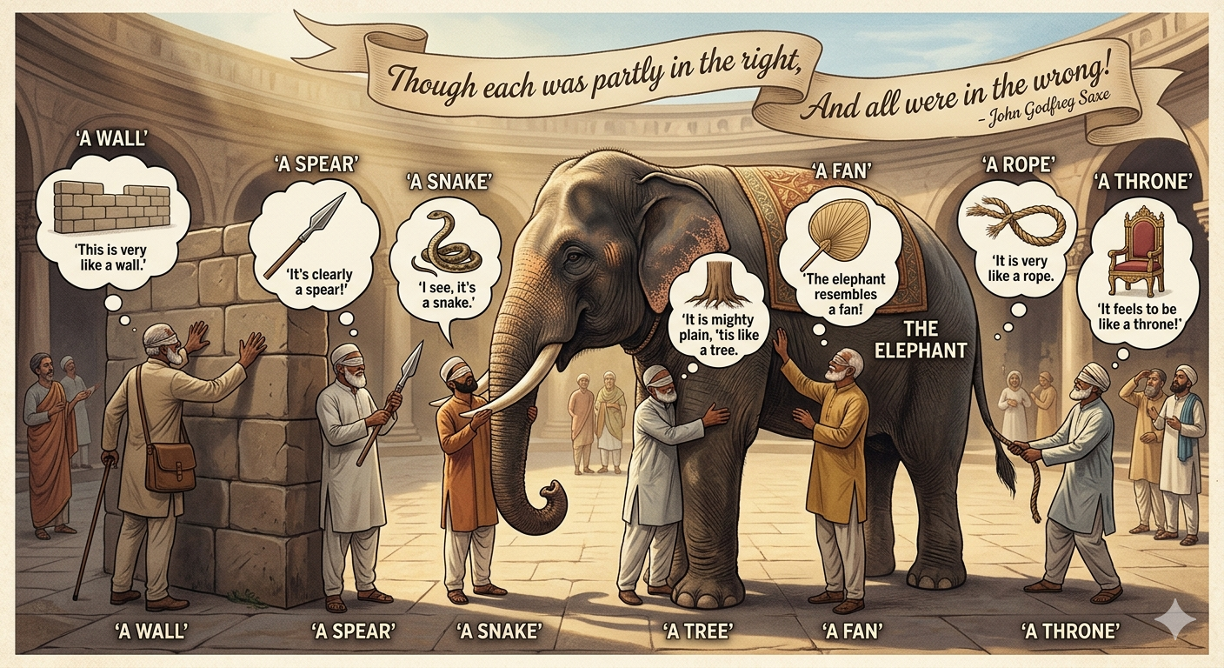
Ask any team in your organisation where the customer data lives and you'll get a confident answer.
Sales will say the CRM. Finance will say the billing platform. Operations will point to order management. Marketing owns the customer data platform.
Every team is right. From their vantage point, they have a single source of truth.
The problem is that no two teams have the same one.
What the Customer Actually Looks Like
Stand in any one system, and the customer looks coherent. Stand at the intersection of all of them, and something different emerges.
Same customer. Multiple versions. No agreed hierarchy for which one wins when they conflict.
Your agents navigate this every day — knowing which system to trust for which query, which data runs a night behind, which identifier doesn't match and needs the Excel lookup to translate it. They do it instinctively, invisibly, without anyone asking them to.
AI has no such instincts. It inherits what it can access. And when systems conflict, it has no judgment to fall back on.
The Band-Aid Inventory
Every organisation has them. Most have never counted them.
The Excel lookup used to reconcile customer IDs between two systems was never properly integrated. The morning report is a manual check conducted before the contact centre opens. The shared inbox agents use when the system shows one thing, and the customer describes another. The overnight script built by someone who left three years ago, documented nowhere, silently load-bearing.
None of these is a failure. They're pragmatic solutions to the gap between how systems were designed and how the business actually operates.
And every one of them is invisible to an AI.
Your CCaaS platform deserves a specific mention here. It was designed to manage interactions — not to be a system of record. But because it's where agents live, it quietly became the most complete record of the customer relationship in many organisations. Disposition codes that drifted in meaning. Wrap-up categories never reconciled with CRM case types. Interaction history that's hard to extract cleanly because the data model is vendor-specific.
When AI needs that history as context, it's frequently one of the hardest integration problems in the project.
The Question Worth Asking
Before your AI project starts, ask every team that touches customer data one question.
Not "Is your data accurate?" Every team will say yes.
"What are you doing manually that the system should be doing automatically?"
The answers are your band-aid inventory. And your bandaid inventory is the real scope of your data integrity work.
Most organisations don't know how many Band-Aids they have until they try to remove them. An AI implementation removes all of them simultaneously — not gradually, but at scale, from day one.
Everyone has a single source of truth. The work is building one that everyone shares.
Next in the Foundation First series: even when data is consistent, there's a third layer that breaks AI implementations quietly — the business rules that exist in practice but nowhere on paper.
Paul Wilson & Canzuki Vendor-agnostic CX consulting across NZ & AU | Problem first. Platform last.