
Before the Door Closes
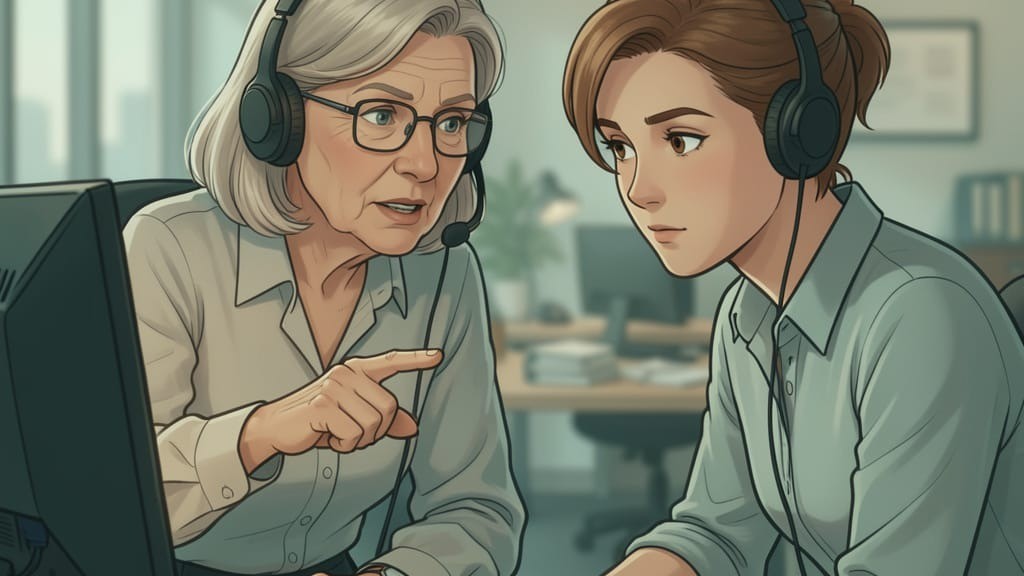
There is a conversation happening in contact centres right now that nobody has scheduled. It happens when a senior agent walks a newer colleague through a tricky interaction. When a team leader explains not just what the policy says but why it exists. When someone who has been doing this job for fifteen years says "watch out for this type of customer — the system will tell you one thing but the reality is usually something else."
It happens informally, in the margins, between other things. And in most organisations, nobody has noticed that AI is making it happen less.
What Gets Lost When Experience Leaves
Think about what a fifteen-year contact centre veteran actually carries.
They know which customer complaints are genuine distress and which are negotiating positions. They know when a billing system flag is a real debt and when it's a data error they've seen a hundred times. They know the product exceptions that never made it into the knowledge base. They know which team to call, which workaround to use, which manager to escalate to when the system doesn't cover the situation.
None of that is written down anywhere. It lives in the person. When that person leaves — retires, moves on, takes redundancy — the knowledge doesn't transfer automatically. It doesn't appear in the handover document. It doesn't get captured in the exit interview. It dissipates.
In the pre-AI era, that loss was painful but manageable. The gap showed up gradually. New agents made mistakes experienced ones wouldn't have made. Standards dipped slightly. Over time, through experience, the new cohort rebuilt some of what was lost.
AI changes that timeline entirely.
The Acceleration Problem
When AI handles the volume, the opportunity to learn through doing disappears.
A junior agent in a pre-AI contact centre handled hundreds of interactions a week. They got things wrong. They observed what happened. They asked questions. They developed pattern recognition through repetition — the same way every expert in every field develops it.
A junior agent in an AI-enabled contact centre handles the interactions the AI can't resolve. The edge cases. The escalations. The complex, ambiguous, emotionally charged situations that don't fit the pattern.
That's exactly backwards from how expertise develops.You don't learn to drive by starting on a motorway at rush hour. You build capability incrementally, in lower-stakes situations, with room to make recoverable mistakes. Strip out the low-stakes interactions and you strip out the learning environment.
The third generation isn't developing the instincts to question AI because they're never in the situations that would build those instincts. The AI handles the straightforward. The humans inherit the hard stuff — without the foundation of ten thousand straightforward interactions that would have prepared them for it.
What Deliberate Transfer Actually Looks Like
This is the part most organisations are not doing. Deliberate knowledge transfer isn't a handover document. It isn't a training manual. It isn't shadowing someone for two weeks before they leave.
It's a sustained, intentional process of making the invisible visible — before the person who holds it walks out the door.
It starts with identifying who holds what. In most contact centres, there are five to ten people whose departure would cause disproportionate damage. Not because of their role or their seniority — because of what they know that nobody else knows. Do you know who they are? Does your organisation have a list?
It moves to structured knowledge capture. Not "write down everything you know" — that produces nothing useful. Specific, scenario-based conversations. "Walk me through the last time the system told you one thing and you knew it was wrong. What did you see? How did you know?" That's the knowledge worth capturing.
It includes deliberate exposure. Pairing experienced practitioners with newer ones — not for shadowing, but for narrated decision-making. "Here's what I'm looking at. Here's what the system is telling me. Here's why I'm not doing what it says." Making the reasoning explicit rather than leaving the junior colleague to reverse-engineer it.
And it requires organisational permission. Senior people don't transfer knowledge if they're too busy handling volume to have the conversation. If the culture treats experience as a personal asset rather than an organisational one, it walks out the door every time someone leaves.
The Window Is Measured in Years, Not Decades
The generation that built contact centre operations from the ground up — who remember manual processes, who understand why certain rules exist, who have the pattern recognition to catch AI when it's wrong — is not going to be available indefinitely.
Retirements are accelerating. Redundancy programmes tied to AI efficiency gains are removing experienced practitioners faster than the knowledge transfer is happening. And every month that passes without deliberate action is a month of institutional knowledge that becomes harder to recover.
This is not a technology problem. No platform will solve it. No AI implementation will capture it as a side effect of going live. It is a leadership decision. Someone in your organisation needs to decide that the knowledge your most experienced people carry is a strategic asset worth protecting — and then protect it, deliberately, before the door closes.
What the Second Generation Owes the Third
In Earthsearch, the drift from tool to authority happened because nobody in the second generation made the transfer explicit. They assumed the third generation would develop the same scepticism naturally. They didn't make the limitations visible. They didn't create the structures that would keep humans meaningfully in the loop.
We are the second generation. The transfer is our responsibility. Not because the third generation is incapable. But because nobody develops scepticism about a system they've never seen fail. Nobody questions authority they've never had reason to doubt. The knowledge that AI can be wrong — specifically, in what circumstances, in what ways — has to be passed on deliberately.
Because the most dangerous thing about the drift from ancillary to authoritative isn't that it happens. It's that by the time you notice, the people who knew better are already gone.
The Human Factor is a series exploring what AI means for the people who work in customer experience.
Canzuki Limited
info@canzuki.com
Auckland, New Zealand
Sydney, Australia
© 2026 Canzuki Limited. All rights reserved.
+64 9 871 4471
Links
Locations