
Empathy Is Not a Soft Skill
The contact centre industry has been trying to systematise empathy for as long as contact centres have existed.
Scripts that say "I understand how frustrating that must be." Training programmes built around tone of voice and active listening. Quality scorecards that award points for empathetic language. Sentiment analysis tools that flag when a customer sounds angry. AI response engines calibrated to mirror emotional language back at the customer with statistically optimised warmth.
All of it is built on the same assumption: that empathy is a behaviour. That if you can identify what empathy looks like and reproduce it consistently, you've solved the problem.
You haven't. You've built a very convincing imitation of it.
And customers — more often than anyone in the industry wants to admit — know the difference.
What AI Empathy Actually Is
When an AI system responds to a distressed customer with "I completely understand how upsetting this must be for you," something specific is happening.
The model has processed the customer's language. It has identified markers associated with emotional distress. It has selected a response with a high probability of being received positively based on training data from thousands of similar interactions.
It is not understanding anything. It has no capacity for understanding. It is producing the statistically likely response to the pattern it has detected.
That's not empathy. It's feigned niceness at scale. Calibrated. Optimised. And hollow.
The problem isn't that AI produces the wrong words. Often the words are exactly right. The problem is that the words are all there is. There's no awareness behind them. No presence. No genuine attention to this specific human in this specific moment.
Customers who are genuinely distressed — not mildly inconvenienced, genuinely distressed — sense the absence. Not always consciously. But the interaction feels transactional even when the language is warm. The empathy lands like a form letter. Technically correct. Personally meaningless.
What Human Empathy Actually Does
Here's where the argument gets interesting — and where the industry has consistently undersold the value of what experienced agents bring.
Empathy in a contact centre isn't primarily a comfort mechanism. It's a diagnostic tool.
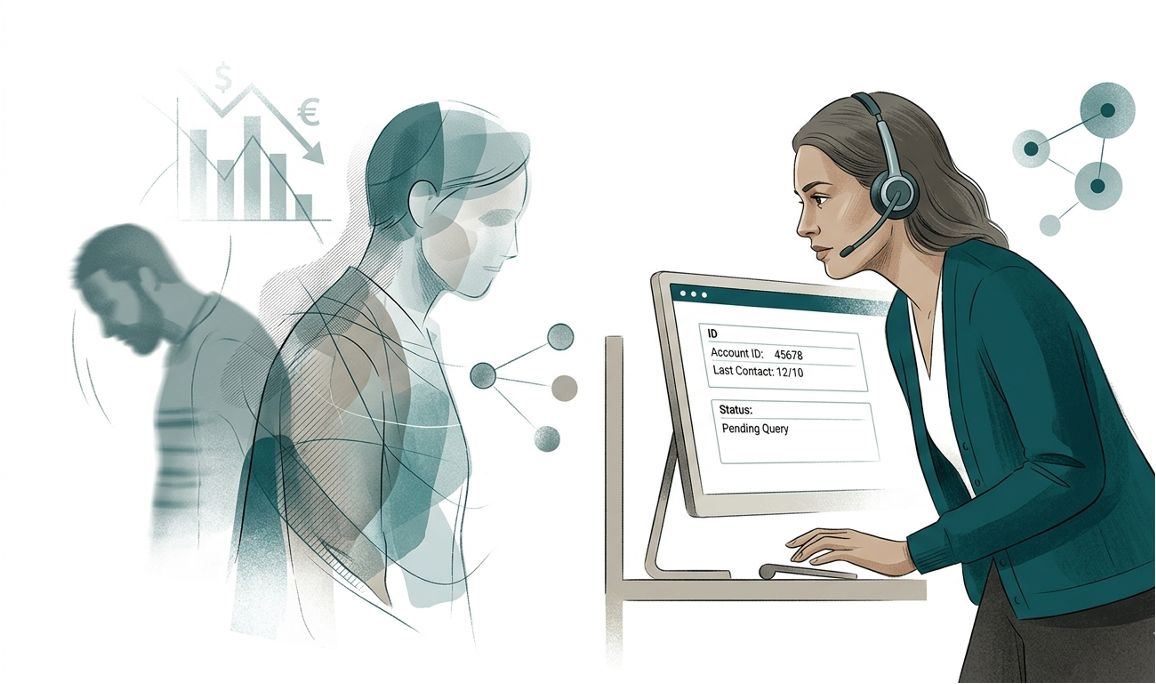
The experienced agent who notices a customer's voice is tight even though the words are polite is not just being kind. They're gathering information. The customer said "fine" in a way that means the opposite. The pause before the answer was a fraction too long. The question about the billing was asked with a specificity that suggests they already know the answer and are testing to see if you do too.
None of that is in the transcript. None of it will appear in the call summary. The sentiment score may read neutral because the language was controlled. The AI will process what was said, not what was meant.
The human agent reads all of it simultaneously — and recalibrates.
They understand that this call isn't really about the billing. It's about six months of feeling ignored. They know that resolving the billing query technically will send this customer away with the right answer and the wrong experience. They adjust. They slow down. They let the customer say the thing they actually came to say.
That adjustment, in that moment, is worth more than any script. And it is entirely invisible to AI.
The Thing Behind the Thing
Every experienced contact centre professional knows about the thing behind the thing.
The customer who calls about a delivery delay but is actually managing a bereavement and has no capacity for another problem. The customer who calls about a billing dispute but is actually in financial distress and too proud to say so directly. The customer who has called three times this week about minor issues because they live alone and the contact centre is the only conversation they've had.
The presenting issue is never the whole story. The human agent who is genuinely paying attention knows this. They've seen it hundreds of times. They've developed the pattern recognition to hear it in the first thirty seconds — not from the words but from everything around the words.
Acting on that information changes outcomes in ways that are real but almost impossible to measure. The de-escalation that didn't make it onto a report because it never became an escalation. The customer who didn't churn because someone treated them like a person at a moment when they needed it. The complaint that never got filed.
AI will never have access to this data because AI cannot attend to a conversation the way a human can. It processes inputs. It does not inhabit the moment.
The Imitation Problem
There is a version of this argument that the industry pushes back on: AI sentiment analysis is getting better. Tone recognition is improving. Models are being trained on more nuanced emotional data. Give it time.
This misunderstands the problem.
The issue isn't the quality of the imitation. A better imitation is still an imitation. And the gap between imitation and presence is not a technical problem waiting to be solved — it's a categorical difference in what's happening.
When an AI produces an empathetic response, it is completing a pattern. When a human produces an empathetic response, they are responding to another person. Those are not the same activity dressed in the same language. One is probabilistic output. The other is human connection.
You can close the gap in the transcript. You cannot close the gap in the experience.
And as AI becomes more prevalent in customer interactions, the customers who reach a human will increasingly be the ones for whom the imitation wasn't enough. The distressed. The complex. The ones who need the real thing.
Which means the humans in your contact centre are not handling the overflow from AI. They are handling the cases where everything the AI has — speed, consistency, scale, calibrated warmth — was insufficient.
That's not a support role. That's the most demanding, highest-stakes work in the operation.
What This Means for How You Value Experience
If empathy is a diagnostic tool — and it is — then it needs to be treated as a professional capability, not a personality trait.
It needs to be developed. Not through scripts that tell agents what to say, but through the kind of experience that builds genuine pattern recognition. Thousands of interactions. Feedback that develops awareness. Mentors who can articulate what they're reading in a conversation and why.
It needs to be protected. The AI efficiency gains that remove low-stakes interactions from human agents aren't just changing volume. They're removing the learning environment in which empathetic capability develops. You cannot build the skill without the repetition.
And it needs to be valued. In a world where AI handles the routine, the humans who can do what AI cannot are not a cost to be optimised. They are the capability that makes the entire operation work when it matters most.
The contact centre of the future is not a room full of people doing what AI can't do yet. It's a room full of people doing what AI will never do — genuinely attending to another human being at a moment that requires it.
Feigned niceness scales. Presence doesn't.
That's not a limitation of AI. It's the definition of what makes us human.
The Human Factor is a series exploring what AI means for the people who work in customer experience.
Paul Wilson
Co-founder, Canzuki | Vendor-agnostic CX consulting across NZ & AU | Problem first. Platform last.
Canzuki Limited
info@canzuki.com
Auckland, New Zealand
Sydney, Australia
© 2026 Canzuki Limited. All rights reserved.
+64 9 871 4471
Links
Locations