
The Calculator Generation
I keep hearing the same worry from people in this industry.
"My skills are worthless now. AI can do in seconds what took me years to learn."
I understand why it feels that way. The tools are extraordinary. The speed is genuinely startling. And the narrative coming from every vendor, every conference stage, and every LinkedIn feed right now is that AI changes everything — implying, sometimes explicitly, that what came before no longer matters.
I want to offer a different way of looking at it.
A Rule I Didn't Understand at the Time
When I was at school, you couldn't use a calculator in a maths exam until you'd passed a certain level without one.
At the time it felt arbitrary. The calculator was right there. It was faster. It didn't make mistakes. Why were we being made to do this the hard way?
The answer, which I only really understood much later, was that a calculator doesn't give you mathematical ability. It amplifies the mathematical ability you already have.
Give a calculator to someone who understands mathematics and they become faster, more accurate, capable of solving problems that would have taken hours by hand. The tool removes the friction and leaves the thinking intact.
Give the same calculator to someone who doesn't understand the fundamentals and you get something different. You get wrong answers delivered with complete confidence. The calculator didn't know the question was set up incorrectly. It didn't know the approach was flawed. It just processed what it was given and returned a result — and that result went into the exam paper as fact.
The calculator wasn't the problem. The absence of foundation was.
AI Is the Most Powerful Calculator Ever Built
I've spent 35 years in telecommunications and contact centre infrastructure. I've watched technology transform this industry multiple times — from analogue to digital, from on-premise to cloud, from rule-based IVR to conversational AI.
Every transition produced the same anxiety. Every transition proved the anxiety partly wrong and partly right in ways nobody predicted.
What I'm watching now is different in scale but not in kind. AI is extraordinary. It can synthesise, summarise, draft, analyse, and respond at a speed no human can match. In the right hands it's transformative.
But here's what the vendor demos don't show you.
AI responds to what it's asked. It doesn't know what it doesn't know. It can't tell you when your question is based on a flawed assumption. It can't flag when the process you've asked it to optimise was broken before you automated it. It will produce a confident, well-structured, entirely plausible answer to a question that shouldn't have been asked — and it will do so without hesitation.
The person who catches that is the person who understands the domain well enough to recognise when something doesn't add up. That's not a junior employee who grew up with AI as a given. That's the experienced professional who spent years developing the judgment that tells them when a result feels wrong before they can even articulate why.
Your experience isn't a liability in an AI world. It's the quality control.
What This Looks Like in a Contact Centre
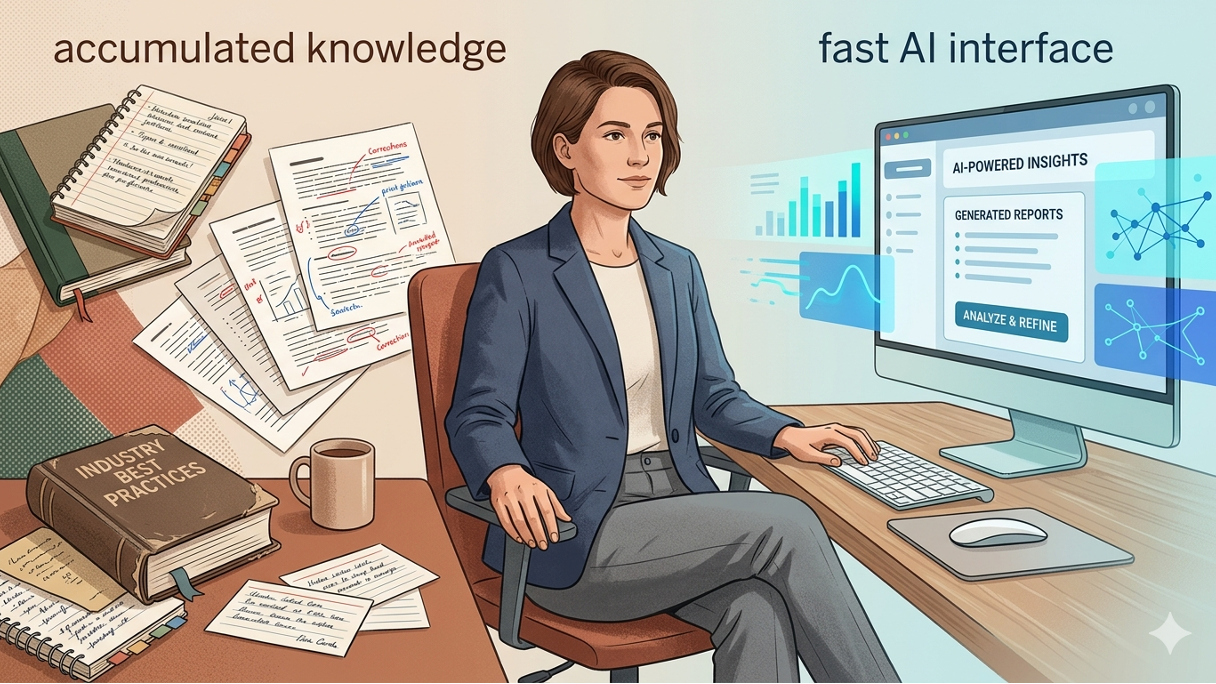
The contact centre professional with fifteen years of experience knows things that aren't written down anywhere.
They know that when a customer calls about a billing dispute and mentions a competitor in the same breath, the conversation is about to go somewhere different. They know which customers are genuinely upset and which are testing the system. They know when a policy answer is technically correct but will make the situation worse. They know the difference between a customer who needs information and a customer who needs to feel heard.
None of that is in the knowledge base. None of it can be prompted out of an AI. It exists in the accumulated pattern recognition of someone who has handled thousands of interactions across years of real situations.
Now give that person an AI tool.
They use it to draft responses faster. To surface relevant policy without digging through documentation. To handle the routine so they can focus on the complex. To catch things they might have missed after a long shift.
The AI handles the volume. The human handles the judgment. The combination is better than either alone.
Now take away the experienced professional and replace them with someone who has always relied on AI to do the thinking.
The AI still drafts the responses. Still surfaces the policy. Still handles the routine. But when the interaction goes somewhere unexpected — when the customer's situation doesn't fit the pattern, when the policy answer is wrong for this specific context, when something feels off — there's nobody in the loop who can catch it.
The calculator is running. Nobody in the room knows enough maths to check the answer.
The Skills You Built Are Not Obsolete
I want to be direct about this because I think the anxiety is real and the dismissal of it isn't helpful.
Yes, some tasks that required skilled humans will be automated. That has always been true of transformative technology and it will be true again. Anyone telling you otherwise is being dishonest.
But the narrative that experience is now worthless — that the years you spent developing judgment, understanding customers, learning the nuances of your industry — misses something fundamental about how AI actually works in practice.
AI in a contact centre is only as good as the humans who define what good looks like, who review what it produces, who catch it when it's wrong, and who escalate when the situation is beyond its capability. Those functions require exactly the kind of expertise that took years to develop.
At Canzuki, we see this in every engagement. The organisations getting the most from AI aren't the ones who replaced their experienced people fastest. They're the ones who put experienced people closest to the AI — defining its boundaries, reviewing its outputs, training it on what good actually looks like in their specific context.
The calculator generation didn't make mathematicians redundant. It made people who understood mathematics more powerful than they had ever been.
That's what AI does to expertise. It doesn't replace it. It multiplies it.
A Question Worth Sitting With
If you're an experienced professional in this industry and you're worried about your future — I'd ask you to consider one thing.
When the AI gets it wrong, who in your organisation will know?
If the answer is you — because you have the domain knowledge, the pattern recognition, the contextual judgment to catch it — then you're not at risk from AI.
You're the person AI can't work safely without.
The Human Factor is a series exploring what AI means for the people who work in customer experience — not the technology, but the humans on both sides of it.
Paul Wilson Co-founder, Canzuki | Vendor-agnostic CX consulting across NZ & AU | Problem first. Platform last.
Canzuki Limited
info@canzuki.com
Auckland, New Zealand
Sydney, Australia
© 2026 Canzuki Limited. All rights reserved.
+64 9 871 4471
Links
Locations