
The Customer You Think You Know
Before your organisation went to market for its last contact centre platform, someone in the room said it.
“We know our customers.”
It’s said in almost every platform evaluation. And it’s almost always true in the way that matters least and false in the way that matters most.
You know your customers in aggregate. You know your top five contact reasons. You know your busiest hours. You know your average handle time and your abandonment rate. You know the score you get on the CSAT survey that 8% of customers complete.
What you probably don’t know — with the precision that AI requires to work effectively — is why your customers are really calling. What they tried before they called. What they were feeling when they gave up on self-service and picked up the phone. What they did after the interaction that your data recorded as resolved.
And here’s the uncomfortable part: the data to answer those questions almost certainly exists in your environment. You’re just not using it.
The Data Is There. The Insight Isn’t.
Modern contact centre environments are generating extraordinary amounts of customer data. Every interaction is transcribed. Customer journeys are mapped across touchpoints. Mood metrics score sentiment at every stage. Interaction history accumulates across every channel.
The gap isn’t the data. It’s what happens to it.
The transcriptions sit in your CCaaS platform, sampled for QA purposes on a fraction of interactions and largely unanalysed beyond that. The journey data is accessible to data analysts with the right tools but invisible to the people making platform decisions. The mood metrics produce scores that populate a dashboard. The dashboard gets reviewed in a weekly meeting. The patterns that would tell you something important about why customers are dissatisfied — the consistent emotional signature of a broken process, the recurring frustration that precedes a churn event — sit in the data unexamined.
You have more customer understanding available to you than you are using. And when you go to market for a new platform, almost none of it informs the decision.
The Silos Are Holding the Insight
Here’s why.
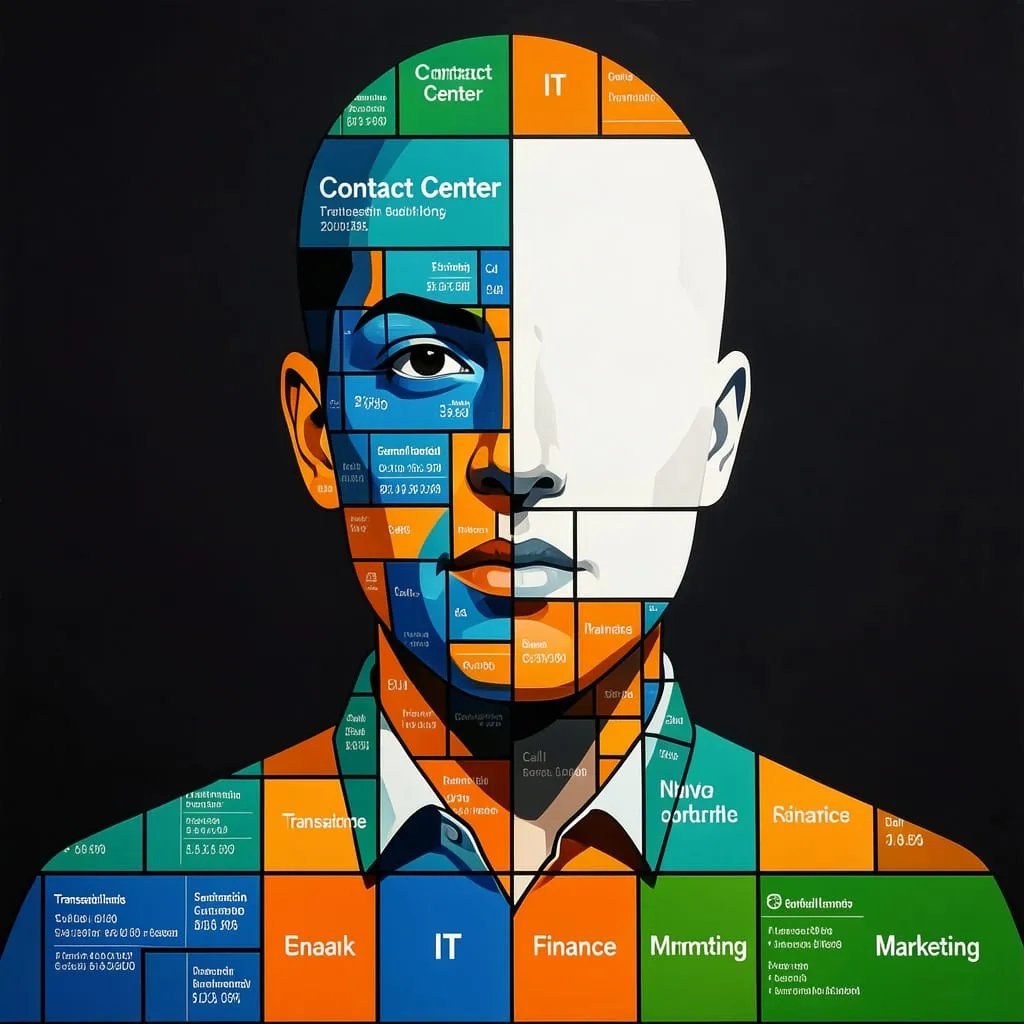
The transcriptions live in the CCaaS platform — owned by contact centre operations. The journey data sits in the analytics tool — owned by IT or digital. The mood metrics are in the quality management system — owned by the QA team. The CRM holds the relationship history — owned by Sales or Customer Success. The billing system holds the account truth — owned by Finance. Web analytics holds the self-service behaviour — owned by Marketing.
Every department has a partial view of the customer. Nobody has the complete one. Because nobody owns the complete one. The insight is distributed across systems and teams that were never designed to share it — and that have no particular incentive to do so.
When the platform decision gets made, it gets made by a project team or procurement function with access to none of this systematically. They pull a report from IT. They get a summary from operations. They run a stakeholder workshop. But the rich, specific, data-derived understanding of who your customers are, what they’re actually trying to achieve, and where your current environment is failing them — that doesn’t make it into the room.
This is the same silo problem that stops AI from working once you’ve deployed it. The data boundaries that prevent your AI from accessing a complete picture of the customer in a live interaction are the same data boundaries that prevent your organisation from understanding your customers well enough to buy the right platform in the first place.
It’s not two problems. It’s one problem showing up twice.
The Four Gaps That Matter
The insight gap. The data exists. Journey maps, mood metrics, transcriptions, interaction history — your environment is full of it. The gap is that nobody has synthesised it into a coherent picture of the customer experience. Not because it’s impossible. Because it’s nobody’s job, or because the silos make it too difficult, or because the project team running the evaluation didn’t know to ask for it.
The silo gap. The insight that does exist is fragmented. The QA manager who has listened to ten thousand calls knows things about your customers that are not in any report. The team leader who sees the mood metric trends every morning has pattern recognition that no dashboard captures. The agent who handles the most complex interactions understands the customer journey failures that never get recorded as failures. None of these people are in the procurement conversation.
The translation gap. Even where insight exists and is shared, it rarely makes it into the RFP in a form that drives meaningful vendor differentiation. “Our customers are frustrated by long hold times” becomes “does the platform have a callback feature?” — a feature every vendor offers. The specific, human understanding of the customer experience doesn’t survive the translation into procurement language. It gets flattened into requirements that could have been written without any customer understanding at all.
The baseline gap. Without a consolidated picture of current performance — drawn from all available data, across all channels, for all customer segments — there is no way to evaluate whether a new platform will actually be better. Better than what? Measured how? Using which data? For which customers?
If you haven’t established the baseline before you go to market, you cannot hold the vendor accountable for improvement after go-live. You’ll be measuring success against the demo, not against your customers’ actual experience.
What Genuine Customer Understanding Looks Like Before an RFP
It starts with the data you already have.
Pull the transcription analysis across a meaningful sample — not a QA sample, a representative one. What are customers actually saying? Not the contact reason they selected, the words they used. What language signals frustration before the agent has said anything? What questions get asked repeatedly that the knowledge base should answer but doesn’t?
Run the journey data. Where are customers dropping out of self-service before reaching an agent? How many contacts does it take to resolve your most common issues? Which customers are calling more than once about the same problem — and what does their mood metric trend look like across those contacts?
Talk to the people who know. Your best agents. Your most experienced team leaders. Your QA analysts. Ask them not what the data says but what they see that the data doesn’t capture. That knowledge is insight the silos are hiding in plain sight.
Break down the customer picture by segment. Your 55-year-old long-tenure customer and your 28-year-old digital native are having completely different experiences of your contact centre. Your data almost certainly shows this if you look for it. Does your platform evaluation reflect both of them?
And then — only then — build your requirements. Not from what platforms can do. From what your customers need.
The Vendor Cannot Give You This
The platform you buy will be as good at serving your customers as your understanding of those customers allows it to be.
A vendor can give you AI that routes intelligently — if you’ve defined what intelligent routing means for your customers. They can give you sentiment analysis that surfaces distress — if you’ve established what distress looks like in your customer base. They can give you journey analytics — if you’ve decided which journeys matter and what good looks like for each of them.
None of that definition is the vendor’s job. It’s yours. And it has to happen before the RFP goes out.
The organisations that go to market with genuine customer understanding — drawn from their own data, synthesised across their own silos, translated into specific requirements that no generic RFP response can satisfy with a yes — are the ones that find customer fit.
The ones who go to market saying “we know our customers” and mean it in the aggregate sense, the top-five-contact-reasons sense, the 8%-CSAT-completion sense — are the ones who buy feature-rich platforms that don’t move the needle.
The data to know your customers better is already in your environment.
The question is whether anyone looks at it before the vendor briefings begin.
Feature Rich. Customer Fit. is a series exploring why the contact centre industry spends more every year and satisfies customers less — and what to do about it
Canzuki Limited
info@canzuki.com
Auckland, New Zealand
Sydney, Australia
© 2026 Canzuki Limited. All rights reserved.
+64 9 871 4471
Links
Locations