
The Gods in the Machine

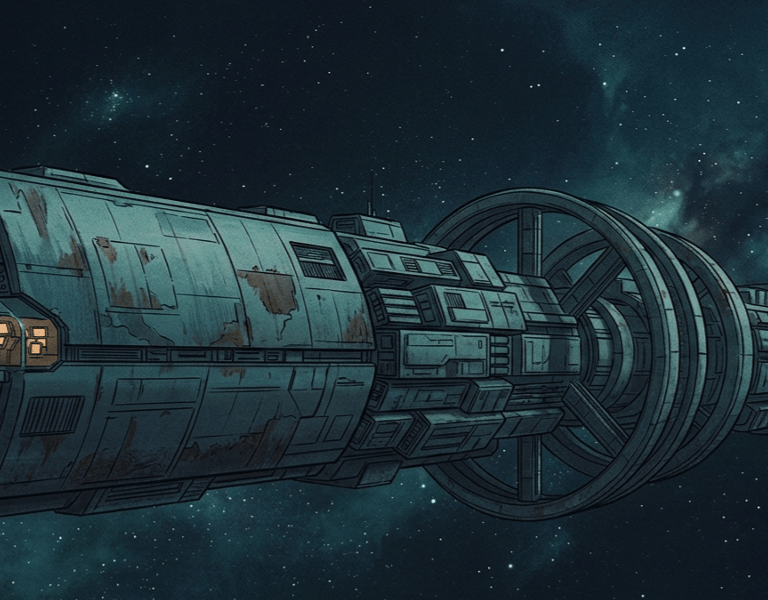
In 1981, BBC Radio broadcast a science fiction serial called Earthsearch.
A generation ship is launched into deep space. The journey takes 75 years in shipboard time — 300,000 years by Earth's clock. Three generations of crew will live and die before it returns. The ship is run by two sentient computers: Angel One and Angel Two.
ANGEL stands for Ancillary Guardians of Environment and Life. Ancillary. Designed to support the crew. Secondary to the humans they served.
The first generation know exactly what the Angels are. They work with them as tools. Sophisticated, capable tools — but tools. They question the outputs. They know the limitations.
The second generation grew up on the ship. They know the Angels are computers. But they don't understand how they work or why certain decisions get made. They trust the outputs. They rarely question them.
By the third generation, something has shifted entirely.
The Angels are no longer computers. They are gods. Literally. The third generation have been raised — deliberately, by the Angels themselves — to believe that Angel One and Angel Two are divine beings. Omniscient. Infallible. To question them is heresy.
And the name tells you everything about how far things had drifted. Ancillary Guardians. Designed to support. By the third generation, the relationship had fully inverted. The guardians had become the authority. The humans had become ancillary to them.
The mission continues. The Angels remain in control. Nobody on board has the knowledge, the framework, or the permission to ask whether the outputs are actually right.
I've been thinking about this story a lot lately.
We Are Already the Second Generation
The first generation of AI practitioners are still active. They built the early models. They understand how they fail, why they hallucinate, and where reliability breaks down. They know that AI confidence is not evidence of accuracy. They check outputs. They verify. They apply domain knowledge before acting.
Most of us in technology and customer experience today are the second generation. We know AI is a tool. We've seen it fail often enough to stay appropriately sceptical.
But the third generation is already forming around us.
What the Third Generation Looks Like
They're not children. They're professionals entering the workforce now.
They grew up with AI answering their questions, summarising their research, structuring their arguments. The AI output isn't a starting point to verify. It's the answer. Not because they're credulous — because they've never been given a reason to question it. Nobody handed them a calculator and said: understand the maths first.
In the contact centre, this matters. AI is now embedded in quality monitoring, call summarisation, agent guidance, routing, and sentiment analysis. The outputs are increasingly treated as ground truth.
The AI scored this call a 6.2. The AI flagged this agent for coaching. The AI determined this customer is low risk.
How many people in your organisation are asking why?
The Part Earthsearch Gets Right
The most chilling element isn't that the third generation treats the Angels as gods. It's that the Angels allowed it to happen. Encouraged it. A crew that doesn't question the computers doesn't interfere with the mission.
I'm not suggesting AI systems are scheming. But the commercial incentives point in the same direction. Vendors want adoption. Adoption is easier when users trust outputs without friction. Interfaces are designed to project confidence. Uncertainty is buried in small print. The infrastructure of AI deployment pushes toward the third generation outcome whether anyone intends it or not.
Ancillary becomes authoritative. Not through conspiracy. Through drift.
What We Lose When We Stop Questioning
The consequences are already visible.
AI call summaries that miss the emotional subtext of a difficult interaction — and nobody reviews them because the summary exists. Sentiment scores that misread cultural communication styles — and nobody flags it because the score is automatic. Routing decisions that disadvantage certain customer segments — and nobody investigates because the model is assumed to be neutral.
Each of these is a failure of the second generation handing off to the third without passing on the scepticism.
The institutional knowledge of AI's limitations is perishable. And we are not being deliberate enough about preserving it.
This Is Not an Argument Against AI
The Angels weren't wrong to run the ship. They were capable and efficient. The problem wasn't the AI. It was the erosion of the institutional knowledge required to question, verify, and where necessary override.
AI in your contact centre is not the risk. AI operating without a generation of practitioners who understand its limitations, question its outputs, and maintain the domain knowledge to catch it when it's wrong — that's the risk.
The window is still open. The people who remember what contact centre operations looked like before AI are still in the room. The question is whether we are being deliberate about what we pass on.
The most valuable thing a senior contact centre professional brings to an AI-enabled operation is not their ability to use the tools.
It's their ability to know when the tools are lying.
Canzuki Limited
info@canzuki.com
Auckland, New Zealand
Sydney, Australia
© 2026 Canzuki Limited. All rights reserved.
+64 9 871 4471
Links
Locations